

Qi Baishi
China, 1864-1957
Artist's works
Artist Profile
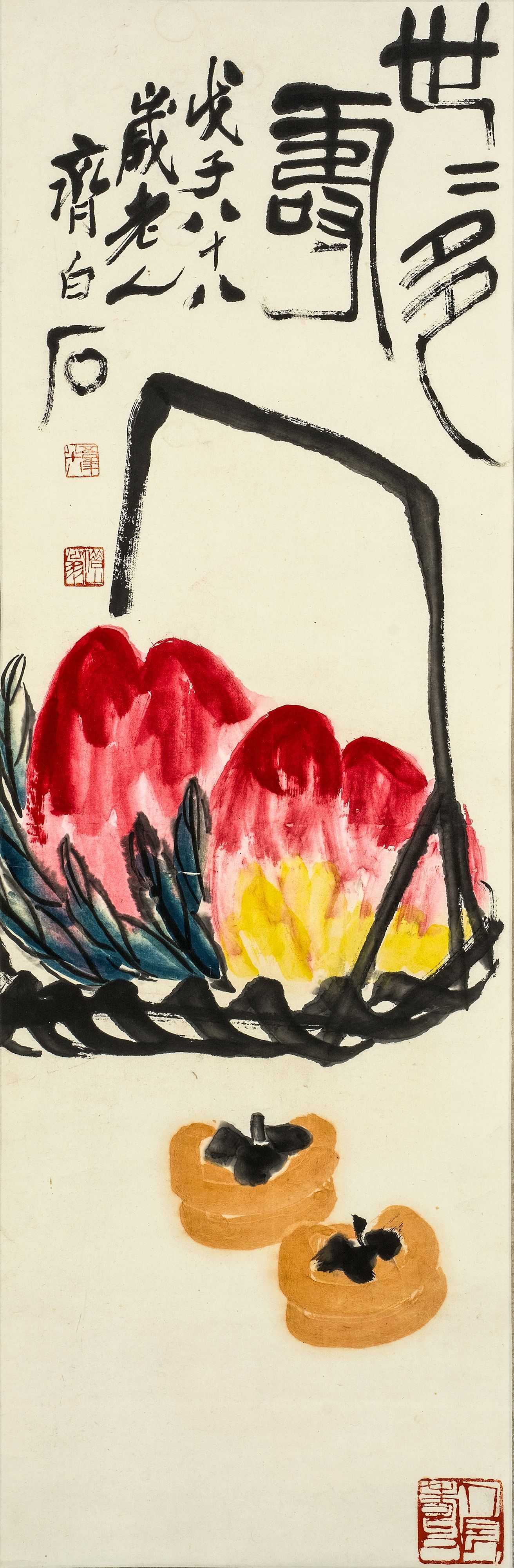
Boundless Longevity
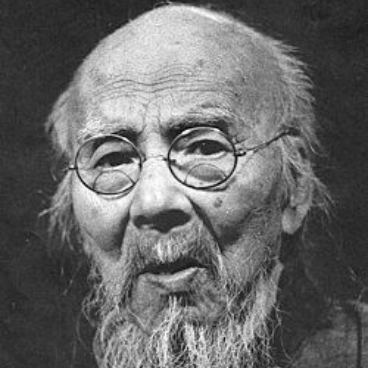
Introduction and Experience
Qi Baishi (1864–1957), born in Xiangtan, Hunan, was one of the most influential Chinese painters of the twentieth century, celebrated alongside Zhang Daqian as a master of modern Chinese art. Coming from a farming family, he worked as a carpenter in his youth while studying painting, calligraphy, poetry, and seal carving—an experience that strengthened his command of line, carving, and brushwork. From the age of forty-two, Qi gradually transitioned from meticulous gongbi painting to expressive xieyi ink painting, developing his distinctive style through bold contrasts of rich vermilion and deep ink.
Qi’s art bridges the refined spirit of literati painting with the vitality of folk culture. Renowned for his lively depictions of shrimp, frogs, insects, flowers, and other familiar subjects, he embraced the principle that painting achieves its subtlety “between resemblance and non-resemblance.” Through simplified compositions, dynamic brushwork, and a compelling balance of strength and delicacy, Qi transformed the ordinary into timeless works of enduring warmth and elegance.
Exhibitions and Awards
Selected Exhibitions
Solo and Retrospective Exhibitions
2025
Qi Baishi: Ink and Color Inspiration —Asian Painting Gallery, Museum of Fine Arts (MFA), Boston, USA
Blooming Lotus and Intertwined Plum Blossoms: The Artistic World of Qi Baishi —Illuminarium at Wynn Palace, Macau, China
2024 – 2025
Unwilling to Be an Immortal: Masterpieces of Qi Baishi from the Beijing Fine Arts Academy Collection —Asian Art Museum of San Francisco, San Francisco, USA
2024
Pen and Axe Through the Millennium: Commemorative Exhibition for the 160th Anniversary of Qi Baishi's Birth —Chan Liu Art Museum (Taipei Branch), Taipei, Taiwan
Little Fish Care: The Lively World of Qi Baishi —Beijing Fine Arts Academy Museum, Beijing, China
2019
Transformation in Innovation, Classic Status —Quanta Arts Foundation (Touring Exhibition), New Taipei City, Taiwan
1984
Commemorative Exhibition of Qi Baishi's Works —National Art Museum of China (NAMOC), Beijing, China
1958
Qi Baishi Posthumous Exhibition —Beijing, China
Group and Joint Exhibitions
2026
Learning from Me Yields Life: Qi Baishi and His Shandong Disciples —Shandong Museum of Art, Shandong, China
Traversing Thousands of Years: Exhibition of Fine Works by Xu Beihong, Qi Baishi, and Chang Dai-Chien from the Xu Beihong Memorial Hall Collection —Guardian Art Center, Beijing, China
Spring Gathering: Chinese Modern Art Masters Exhibition —Hong Kong Culture Expo, Hong Kong, China
2025
Between Brush and Ink: Friendship and Character Under the Masters' Brushes —Chan Liu Art Museum (Taipei Branch), Taipei, Taiwan
2016
Two Shis Strategy: Qi Baishi and Shi Lu —Sun Museum, Hong Kong, China
Collections
Museum and Institutional Collections
- Beijing Fine Arts Academy Museum—Beijing, China
- The Palace Museum—Beijing, China
- Three Gorges Museum—Chongqing, China
- Hunan Museum—Hunan, China
- Former Residence of Qi Baishi Memorial Hall—Beijing, China
- National Gallery Prague—Prague, Czech Republic
- Kyoto National Museum—Kyoto, Japan
- Chan Liu Art Museum—Taipei, Taiwan
Private Collections
- Works are held in private collections in Taiwan, China, and worldwide.